Flowcharts and pseudocode
An algorithm can be shown two ways. A flowchart draws it with standard symbols joined by arrows. Pseudocode writes it in short, structured English, such as Read price. Both use the same building blocks: input, processing, output, decisions and loops. Paper 1 asks which structure IF ... THEN ... ELSE belongs to: selection.
By the end of this page you can
- Name the flowchart symbols and what goes in each
- Use operators, including MOD and DIV
- Tell sequence, selection and loops apart
- Put an algorithm’s statements in order
- Write a short algorithm in pseudocode
Goals tick themselves off as you try the activities below.
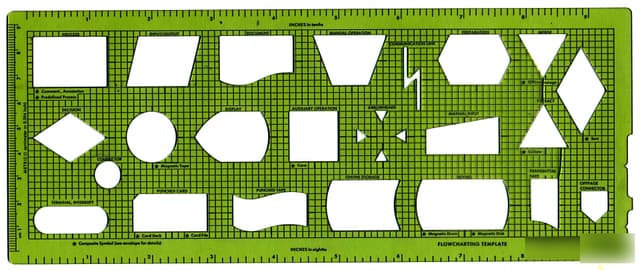
Photo: Spideog, CC BY-SA 4.0, via Wikimedia Commons. Maker’s logo and part number blurred, resized, JPEG q74.
Programmers once drew flowcharts with templates like this: each shape has one job.
How often it shows up in past papers
All papers13 of 14 papers
Last 55 of 5 · 2019–2025
Paper 1 counts come from our past-paper bank of CSEC Information Technology Paper 1s. The last-5 row shows how often it came up in the five most recent papers.
Inside this topic
- Symbols and statementsLocked
- Control structuresLocked
- Build an algorithmgameLocked
- Key termsLocked
- Test yourselfmarkedLocked
- Practise for real · 1 past questionLocked