File organisation and access
A file holds records, one for each customer, student or product. How they are arranged decides how fast one is found. On a magnetic tape, records are read in order from the first; on a disk, the computer can go directly to the record it needs. Paper 1 asks what is true of sequential access: it starts with the first record.
By the end of this page you can
- Tell sequential and direct access apart
- Explain master and transaction files
- Describe the four access methods
- Choose a file organisation for an application
Goals tick themselves off as you try the activities below.
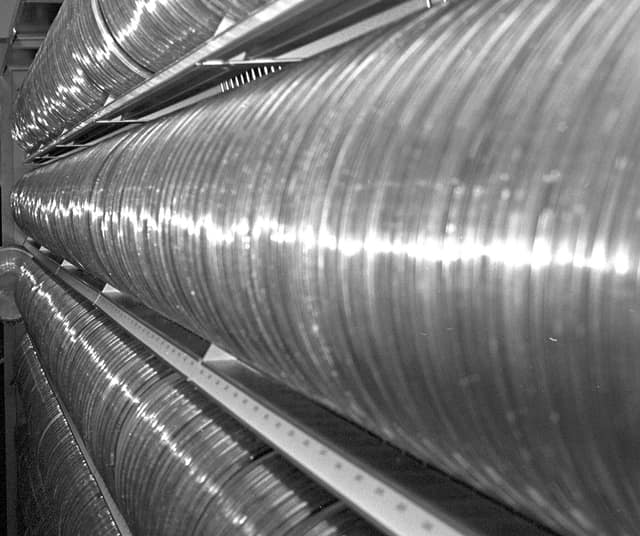
Photo: U.S. Department of Agriculture, Public domain, via Wikimedia Commons. Cropped to one row of racks, resized, JPEG q72.
Tape stores records one after another: to reach record 50, read records 1 to 49 first.
How often it shows up in past papers
Paper 1 counts come from our past-paper bank of CSEC Information Technology Paper 1s. The last-5 row shows how often it came up in the five most recent papers.
Inside this topic
- Tape and diskLocked
- Four ways to reach a recordLocked
- Key termsLocked
- Test yourselfmarkedLocked
- Practise for real · 1 past questionLocked