Xylem and transpiration
Water climbs from the roots to the leaves through the xylem, and most of it then escapes from the leaves as vapour: transpiration. On hot, dry Caribbean coasts, plants like this cactus survive by saving every drop.
By the end of this page you can
- Explain how xylem suits its job, why plants transpire, and how dry-land plants save water
- Say how light, temperature, humidity and wind change the rate of transpiration
- Trace water from the root hairs out into the air
- Define xylem, lignin, transpiration, stomata and xerophyte
- Explain the effect of wind and humidity on transpiration
Goals tick themselves off as you try the activities below.
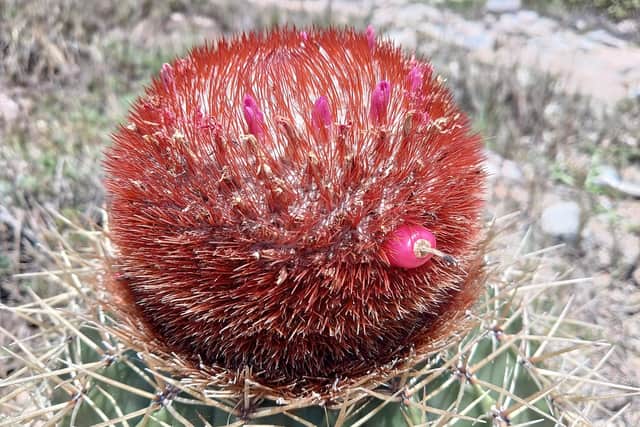
Photo: Donald McAninch, CC BY 4.0, via Wikimedia Commons. Cropped, resized, JPEG q66.
The Turk’s cap cactus stores water in its fleshy stem, and its leaves are spines that lose almost none.
How often it shows up in past papers
Paper 1 counts come from our past-paper bank of CSEC Biology Paper 1s. Paper 2 is not included yet.
Up the pipes, out of the pores
How water travels, why it leaves, and how dry-land plants hold on to it. Tap each card.
What speeds it up, what slows it down
Tap each factor or adaptation to see how it changes water loss.
Faster or slower?
Tap a factor or an adaptation on the list.
Try it: stand two leafy shoots in water under a film of oil, one by a fan, one in still air. After a day, the one in the breeze has taken up more water.
From root to air
Follow water through a plant: drag or tap each card into its slot.
Where does water enter the plant?
Seven terms to know cold
Say what each term means before you flip the card. Rate answers need the word gradient.
Six quick questions, then a real one
Pick an answer to see why it’s right or wrong.
Xylem vessels are
In which conditions is transpiration fastest?
Lignin in xylem walls
A celery stalk stands in red dye for a day. Which tissue turns red?
Humid air slows transpiration because
Which is NOT an adaptation for saving water?
exam style · 4 marks
Describe and explain the effect of (a) wind and (b) humidity on the rate of transpiration.
Sign in to have your answer marked, or check it against the mark scheme. Sign in
Practice questions are written by My V.I.P. Academy. They are not official CXC papers.