Movement and the skeleton
Your skeleton has about 206 bones, and every one is living tissue, with its own blood supply. It holds you up, guards your organs, lets you move and even makes your blood cells.
By the end of this page you can
- Tell growth movements in plants from locomotion in animals
- Give the four functions of the human skeleton, with examples
- Name the regions of the backbone in order
- Tell ligaments, tendons and cartilage apart
- Answer exam questions on movement and the skeleton
Goals tick themselves off as you try the activities below.
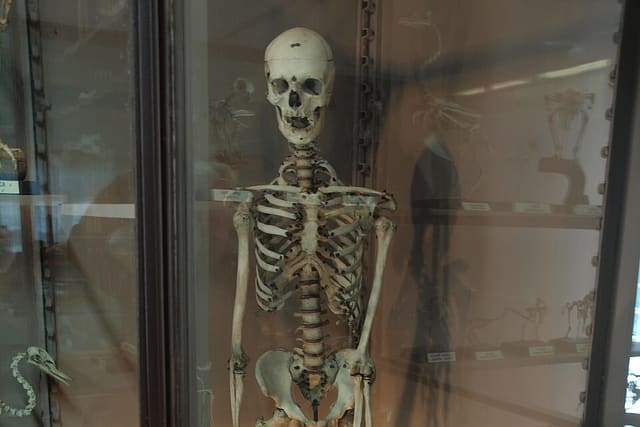
Photo: JIP, CC BY-SA 3.0, via Wikimedia Commons. Cropped.
A human skeleton in a museum. The skull, backbone and ribs form the axial skeleton; the limbs and girdles form the appendicular skeleton.
How often it shows up in past papers
Paper 1 counts come from our past-paper bank of CSEC Biology Paper 1s. Paper 2 is not included yet.
Two very different kinds of movement
Plants move by growing: slowly, part of the plant at a time, and the change is not undone. Most animals move the whole body from place to place: locomotion. Tap each card.
Four jobs of the skeleton
The skeleton does far more than hold you up. Tap each job to see an example.
What do bones do?
Tap a job on the list to see an example.
Bone is living tissue with cells and a blood supply. That is why a broken bone can heal.
Down the backbone, neck to tail
The backbone is a chain of vertebrae. Order its regions from the neck down: drag or tap each card into its slot.
Which region is at the top?
Seven terms to know cold
Say what each term means before you flip the card. Ligament, tendon and cartilage are the trio examiners mix together.
Six quick questions, then a real one
Pick an answer to see why it’s right or wrong.
Which of these BEST describes movement in plants?
Which is LEAST likely to be a growth movement?
Which of these is a function of the human skeleton?
The MAIN function of cartilage at the ends of long bones is to
Which vertebrae have the largest centrum, to support the weight of the body?
Which statement about the skeleton is NOT correct?
exam style · 3 marks
Explain why most animals need to move from place to place but flowering plants do not.
Sign in to have your answer marked, or check it against the mark scheme. Sign in
Practice questions are written by My V.I.P. Academy. They are not official CXC papers.