Meiosis
Every sperm, egg and pollen grain is made by meiosis, a cell division that halves the number of chromosomes and shuffles the genes. It is why you have half your genes from each parent, and why you are not quite like anyone else.
By the end of this page you can
- Say where meiosis happens, why it halves the chromosome number, and how it makes variation
- Compare mitosis and meiosis point by point
- Describe what happens in meiosis, in order
- Use the key terms correctly
- Explain why meiosis matters in sexual reproduction
Goals tick themselves off as you try the activities below.
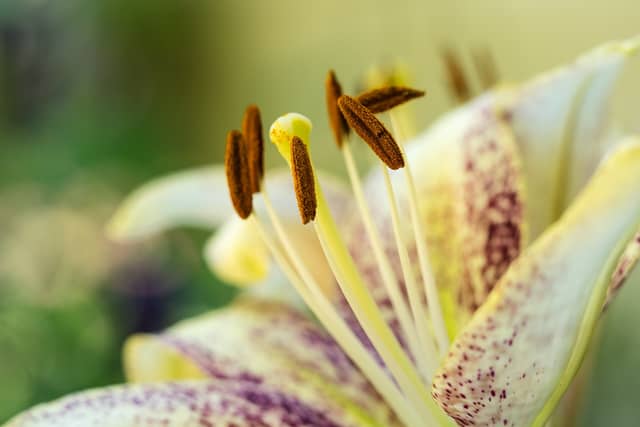
Photo: Aislinn Wildrose, CC BY 3.0, via Wikimedia Commons. Cropped, resized, JPEG q70.
Inside each brown anther, cells divide by meiosis to make pollen. The real cells on this page come from lily anthers like these.
How often it shows up in past papers
Paper 1 counts come from our past-paper bank of CSEC Biology Paper 1s. Paper 2 is not included yet.
Half the chromosomes, a new mix every time
Where meiosis happens, why it halves the number, and why it makes everyone different. Tap each card.
Two divisions, side by side
Tap each point to compare mitosis with meiosis.
Mitosis or meiosis?
Tap a point on the list to compare the two divisions.
Exam tip: compare them in a table, one row per point, and write both sides in every row.
Four steps, two divisions
Press Play it through, tap a step, or drag the slider. Homologous pairs: the mother’s chromosome is blue, the father’s gold.
CSEC does not ask for stage names (such as prophase I): describe what happens.
from the motherfrom the fathercentromere
Pairs form
Stage 1 of 4Matching chromosomes find each other.
- The DNA was copied before meiosis, so each chromosome is two sister chromatids joined at a centromere.
- Homologous chromosomes, one from the mother and one from the father, carry genes for the same features. They line up side by side in pairs.
- The nuclear membrane breaks down.
If you have to draw it: For each pair, two X-shaped chromosomes of the same size side by side.
4 chromosomes in 2 pairs, each made of 2 chromatids
Put meiosis in order
Drag or tap each card into its slot. Use the clue on each card.
What has to happen before the cell can divide?
Seven terms to know cold
Say what each term means before you flip the card. “Homologous” earns marks that “similar” does not.
Six quick questions, then a real one
Pick an answer to see why it’s right or wrong.
How many chromosomes are in a human sperm cell?
In a flowering plant, meiosis takes place in the
Crossing over happens between
At the end of meiosis there are
Why must gametes be haploid?
Which is TRUE of meiosis but NOT of mitosis?
exam style · 4 marks
Explain why meiosis is important in sexual reproduction.
Sign in to have your answer marked, or check it against the mark scheme. Sign in
Practice questions are written by My V.I.P. Academy. They are not official CXC papers.