The leaf, the rate of photosynthesis and minerals
Every stalk of sugar cane is built from carbon dioxide and water, joined by light in the leaf. How well a leaf does this depends on its structure, on the weather, and on minerals from the soil.
By the end of this page you can
- Explain how a leaf is built for photosynthesis, what limits its rate, and why plants need nitrogen and magnesium
- Give the job of each layer in a leaf
- Trace carbon dioxide from the air into starch
- Define palisade and spongy mesophyll, limiting factor and variegated
- Explain how a leaf’s inside suits photosynthesis
Goals tick themselves off as you try the activities below.
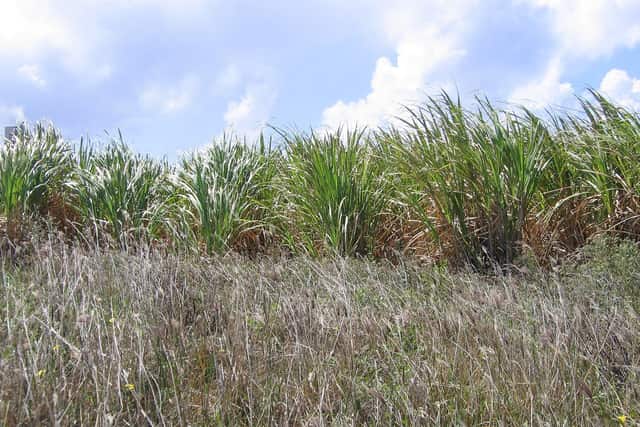
Photo: Postdlf, CC BY-SA 3.0, via Wikimedia Commons. Cropped, resized, JPEG q62.
Sugar cane in Saint Lucy, Barbados: some of the fastest photosynthesisers on Earth.
How often it shows up in past papers
Paper 1 counts come from our past-paper bank of CSEC Biology Paper 1s. Paper 2 is not included yet.
Built for light, limited by the weather
Tap each card.
Six layers, six jobs
Tap a layer, from the top of the leaf down.
What does it do?
Pick a layer on the list.
Outside, look for the blade (lamina), the leaf stalk (petiole) and the midrib with veins branching from it.
From air to starch
Follow one carbon dioxide molecule: drag or tap each card into its slot.
Where does it enter the leaf?
Seven terms to know cold
Say what each term means before you flip the card. Link each structure to its job.
Six quick questions, then a real one
Pick an answer to see why it’s right or wrong.
Most chloroplasts in a leaf are in the
The air spaces in the spongy mesophyll
A variegated leaf is tested for starch. The result:
On a warm, bright day the rate stops rising as light increases. What is most likely limiting it?
A plant short of magnesium has yellow leaves because it cannot make
Nitrogen is needed by plants mainly to make
exam style · 4 marks
Explain how the internal structure of a leaf is adapted for photosynthesis.
Sign in to have your answer marked, or check it against the mark scheme. Sign in
Practice questions are written by My V.I.P. Academy. They are not official CXC papers.