How the arm moves
Muscles can only pull, never push. So every movement of your arm needs two muscles working as a pair, pulling on bones that pivot at joints.
By the end of this page you can
- Name the hinge and ball-and-socket joints of the arm and how each moves
- Label the parts of a long bone and say what each does
- Put the steps of bending the arm in order
- Define antagonistic muscles, flexor, extensor and synovial fluid
- Explain how the biceps and triceps bend and straighten the arm
Goals tick themselves off as you try the activities below.
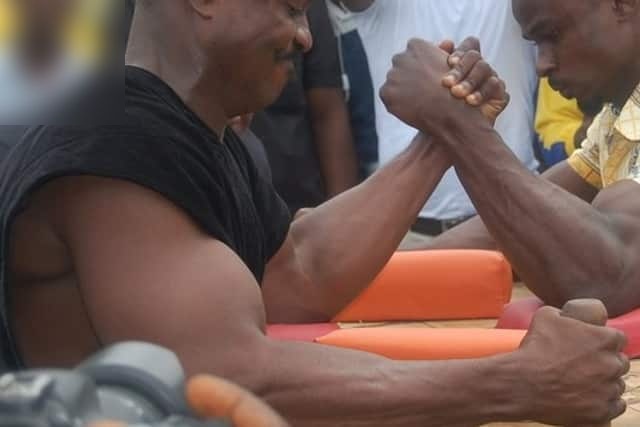
Photo: Osy, CC BY-SA 4.0, via Wikimedia Commons. Cropped, a bystander’s face blurred, resized, JPEG q64.
In arm wrestling, the biceps of each arm contracts hard to hold the elbow bent.
How often it shows up in past papers
Paper 1 counts come from our past-paper bank of CSEC Biology Paper 1s. Paper 2 is not included yet.
Two joints, one muscle pair
Tap each card.
Inside the humerus
Tap a part to see what it does. Learn to draw and label it.
What does it do?
Pick a part on the list.
Draw the bone long and narrow: wide ends of spongy bone capped with cartilage, and a hollow shaft of compact bone.
Bending the arm
Drag or tap each card into its slot.
What tells the muscle to work?
Six terms to know cold
Say what each term means before you flip the card. Then point to it on your own arm.
Six quick questions, then a real one
Pick an answer to see why it’s right or wrong.
When the arm bends at the elbow,
Why do muscles work in antagonistic pairs?
The shoulder is a ball-and-socket joint, so it
What attaches a muscle to a bone?
Red marrow, which makes blood cells, is found in
Which joint is immovable (fixed)?
exam style · 4 marks
Describe how the biceps and triceps bring about bending and straightening of the arm at the elbow.
Sign in to have your answer marked, or check it against the mark scheme. Sign in
Practice questions are written by My V.I.P. Academy. They are not official CXC papers.