Habitats, niches and the non-living world
A mangrove root is a habitat: the place where crabs, young fish and corals live. Each of them also has a niche, its job there. This page sorts out the ecology words examiners test most.
By the end of this page you can
- Explain how light, water, temperature and soil affect where organisms live
- Describe what soil is made of and why each part matters
- Put organism, population, community and ecosystem in order
- Tell a habitat from a niche, and a population from a community
- Answer exam questions on ecological terms and soil
Goals tick themselves off as you try the activities below.
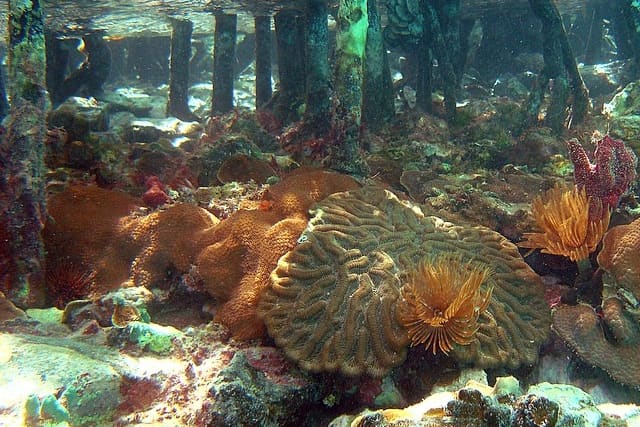
Photo: Caroline Roger, USGS, Public domain, via Wikimedia Commons. Cropped.
Under red mangroves in the US Virgin Islands, corals and fanworms grow among the roots and young fish shelter between them.
How often it shows up in past papers
Paper 1 counts come from our past-paper bank of CSEC Biology Paper 1s. Paper 2 is not included yet.
The non-living world decides who lives where
Living things around an organism are biotic factors. The non-living parts, such as light, water, temperature and soil, are abiotic factors. Tap each card to see one at work.
Soil is more than dirt
A fertile soil mixes four things, and plants need every one. The dark top layer in the Soil card’s photo is rich in humus.
What is in the soil?
Tap a part on the list to see what it does for plants.
The amounts vary from soil to soil; these are typical of a fertile loam. Soil is also full of living things, such as earthworms and bacteria.
From one organism to a whole ecosystem
Put the levels in order, from the smallest to the largest. Drag or tap each card into its slot. Each level contains the one before it.
Which level is the smallest?
Seven terms to know cold
Say what each term means before you flip the card. Examiners often ask you to tell two of them apart.
Six quick questions, then a real one
Pick an answer to see why it’s right or wrong.
Which pair correctly defines a niche and a habitat?
Fish, snails, water grass and tadpoles living in a freshwater pond are best described as
Which list contains only abiotic factors?
A 50 g soil sample is heated at 110 °C until its mass stops falling. It now weighs 38 g. What was lost?
Which statement about humus is NOT true?
Why can most plants not grow in waterlogged soil?
exam style · 2 marks
Distinguish between a population and a community.
Sign in to have your answer marked, or check it against the mark scheme. Sign in
Practice questions are written by My V.I.P. Academy. They are not official CXC papers.