Food tests
A few drops of the right chemical can show what a food contains. Each food test has its own colour change, and knowing the method and the positive result earns reliable marks.
By the end of this page you can
- Explain the starch and sugar tests, and how big food molecules are built and broken down
- Give the method and positive result of each food test
- Put the test for a non-reducing sugar in order
- Define reducing sugar, hydrolysis, condensation and emulsion
- Describe the tests for protein and fat
Goals tick themselves off as you try the activities below.
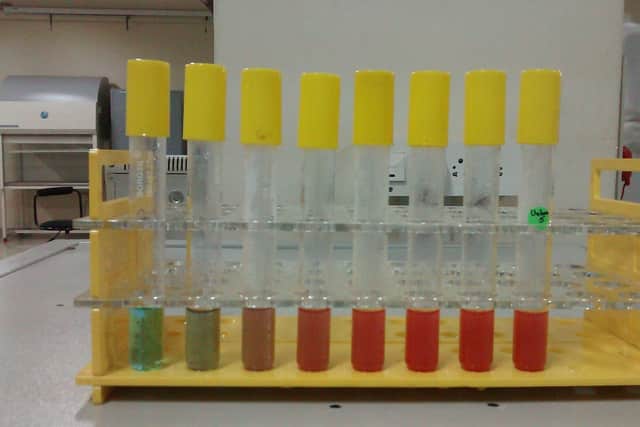
Photo: Psgs123xyz, CC0, via Wikimedia Commons. Cropped, resized, JPEG q66.
Benedict’s test on solutions with more and more sugar, left to right: green means a little, brick-red a lot.
How often it shows up in past papers
Paper 1 counts come from our past-paper bank of CSEC Biology Paper 1s. Paper 2 is not included yet.
Read the colour
Tap each card.
Method and positive result
Tap a test to see how it is done and what a positive result looks like.
How is it done?
Pick a test on the list.
Always include a control (water instead of food) so you can see the colour without the food.
Testing for sucrose
Drag or tap each card into its slot.
What does the first test show?
Seven terms to know cold
Say what each term means before you flip the card. Give the colour change, not only the final colour.
Six quick questions, then a real one
Pick an answer to see why it’s right or wrong.
Iodine solution with starch turns
A positive Benedict’s test gives
The Biuret test is positive for protein when the colour turns
Sucrose gives a positive Benedict’s test only after it is
The ethanol emulsion test is used to detect
Hydrolysis means
exam style · 4 marks
Describe how you would test a sample of food for (a) protein and (b) fat.
Sign in to have your answer marked, or check it against the mark scheme. Sign in
Practice questions are written by My V.I.P. Academy. They are not official CXC papers.