Flowers and pollination
A flower is a plant’s way of reproducing sexually. Its colours, scents and shapes all serve one job: getting pollen from one flower to another, so that fertilisation can make seeds.
By the end of this page you can
- Compare insect- and wind-pollinated flowers, and tell pollination from fertilisation
- Give the job of each part of a flower
- Follow pollen from the anther to a seed
- Define stamen, carpel, cross- and self-pollination, and micropyle
- Distinguish pollination from fertilisation
Goals tick themselves off as you try the activities below.
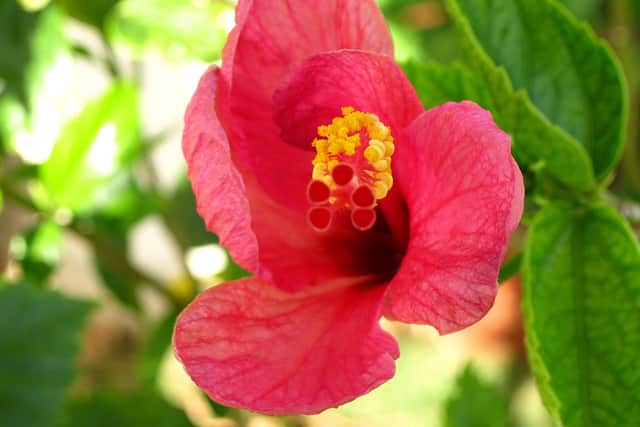
Photo: FabSubeject, CC BY-SA 3.0, via Wikimedia Commons. Cropped, resized, JPEG q64.
In a hibiscus the anthers (yellow) and stigmas (red tips) stand out on a column, where visitors brush past them.
How often it shows up in past papers
Paper 1 counts come from our past-paper bank of CSEC Biology Paper 1s. Paper 2 is not included yet.
Two ways to move pollen, one way to make a seed
Tap each card.
Each part, its job
Tap a part to see what it does.
What does it do?
Pick a part on the list.
Male parts: the stamen (anther and filament). Female parts: the carpel (stigma, style and ovary). The micropyle is the small gap the pollen tube enters by.
From pollen to seed
Drag or tap each card into its slot.
Where does it start?
Seven terms to know cold
Say what each term means before you flip the card. Never use pollination and fertilisation as if they were the same.
Six quick questions, then a real one
Pick an answer to see why it’s right or wrong.
Which part of a flower receives pollen?
Which is a feature of a wind-pollinated flower?
After fertilisation the ovary becomes the
Pollination is the
A large, red hibiscus flower with nectar is most likely pollinated by
An advantage of cross-pollination is that it
exam style · 4 marks
Distinguish between pollination and fertilisation in a flowering plant.
Sign in to have your answer marked, or check it against the mark scheme. Sign in
Practice questions are written by My V.I.P. Academy. They are not official CXC papers.