Enzymes
Green papaya makes tough meat tender, because it contains an enzyme that breaks down protein. Your body runs on thousands of enzymes: without them, digestion would take years.
By the end of this page you can
- Explain what enzymes are and how temperature and pH affect them
- Name the digestive enzymes, where they work and what they digest
- Describe how an enzyme acts on its substrate
- Define catalyst, substrate, active site, optimum and denatured
- Explain a temperature graph for an enzyme
Goals tick themselves off as you try the activities below.
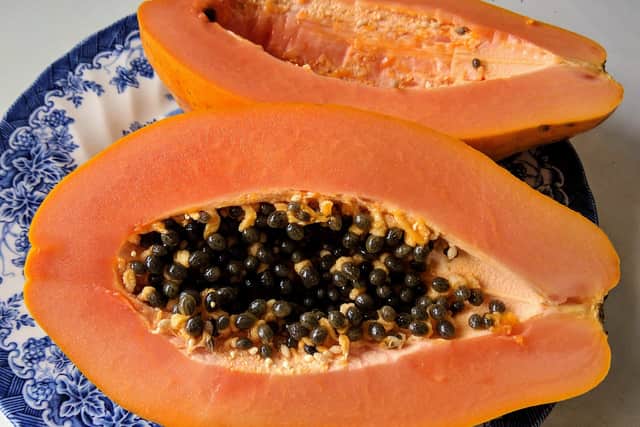
Photo: Maksym Kozlenko, CC BY-SA 4.0, via Wikimedia Commons. Cropped, resized, JPEG q66.
Papaya contains papain, a protein-digesting enzyme used as a meat tenderiser.
How often it shows up in past papers
Paper 1 counts come from our past-paper bank of CSEC Biology Paper 1s. Paper 2 is not included yet.
Fast, specific, and fussy
Tap each card.
Six enzymes along the gut
Tap an enzyme to see where it works and what it digests.
Where and what?
Pick an enzyme on the list.
Each enzyme is named after its substrate: amyl- for starch (amylose), lip- for lipids, malt- for maltose.
How an enzyme works
Drag or tap each card into its slot.
What must meet the enzyme?
Seven terms to know cold
Say what each term means before you flip the card. Say denatured, never “killed”.
Six quick questions, then a real one
Pick an answer to see why it’s right or wrong.
Enzymes are
Above its optimum temperature, an enzyme’s activity falls because it is
Pepsin works best at about
An enzyme works on only one substrate because
Catalase breaks hydrogen peroxide down into
Amylase activity was 2, 5, 9, 12, 6 and 1 units at 10, 20, 30, 40, 50 and 60 °C. The optimum is about
exam style · 4 marks
An enzyme’s activity rises from 20 °C to 40 °C, then falls sharply to zero at 60 °C. Explain these results.
Sign in to have your answer marked, or check it against the mark scheme. Sign in
Practice questions are written by My V.I.P. Academy. They are not official CXC papers.