Energy flow
This kestrel is eating a lizard that ate insects that ate plants. The energy in its meal started as sunlight. At every step most of it was lost, which is why there are far fewer kestrels than lizards. Energy flows one way through a food chain; it is never recycled.
By the end of this page you can
- Explain how energy enters a food chain and how it is lost
- Name the trophic levels of a food chain
- Show that energy decreases at each level
- Define producer, trophic level and energy flow
- Answer exam questions on energy flow
Goals tick themselves off as you try the activities below.
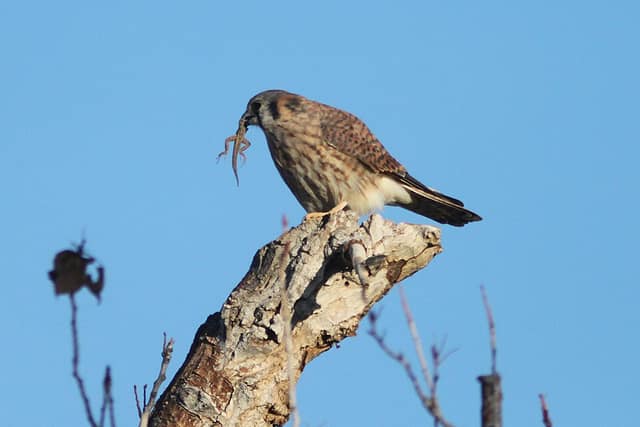
Photo: ALAN SCHMIERER, CC0, via Wikimedia Commons. Cropped, JPEG q72.
An American kestrel, a falcon found across the Caribbean, with a lizard. It sits at the top of its food chain.
How often it shows up in past papers
Paper 1 counts come from our past-paper bank of CSEC Biology Paper 1s. Paper 2 is not included yet.
In from the sun, out at every step
Only part of the energy at one level reaches the next. Tap each card to see where it comes from and where the rest goes.
Six roles in one chain
Each feeding level is a trophic level. Tap each to see a Caribbean grassland example and its energy.
Who eats whom?
Tap a role on the list to see its example and its energy.
Minerals cycle round and round; energy flows one way, from the sun out as heat. That is why the syllabus calls it non-cyclic.
Most energy to least
Put the food chain in order from the most energy to the least. The figures are an example, but the pattern is always the same. Drag or tap each card into its slot.
Where does all the energy come from?
Seven terms to know cold
Say what each term means before you flip the card. Energy questions reward “lost as heat” and “respiration”.
Six quick questions, then a real one
Pick an answer to see why it’s right or wrong.
What is the original source of energy for almost all food chains?
Why are there fewer kestrels than grasshoppers in a habitat?
In which form is most energy lost between trophic levels?
Which statement is correct?
Grass holds 20 000 kJ of energy. If about a tenth passes to the next level, how much reaches the herbivores?
Decomposers obtain their energy from
exam style · 3 marks
Explain why food chains rarely have more than four or five trophic levels.
Sign in to have your answer marked, or check it against the mark scheme. Sign in
Practice questions are written by My V.I.P. Academy. They are not official CXC papers.