Decomposers and special relationships
Every dead leaf and fallen mango disappears in the end, eaten by decomposers. And many living things live in close partnership: some help each other, some take without giving.
By the end of this page you can
- Explain what decomposers do, and describe three kinds of relationship
- Name the partners in each relationship and who gains
- Trace a dead leaf back into the soil
- Define decomposer, parasitism, commensalism and mutualism
- Tell parasitism from mutualism with named examples
Goals tick themselves off as you try the activities below.
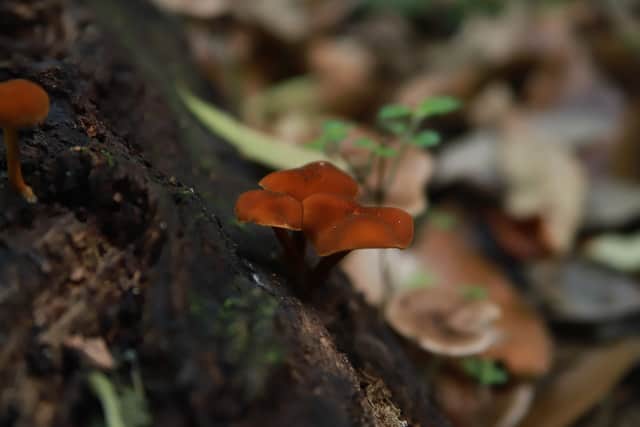
Photo: Krishna k. sahh, CC0, via Wikimedia Commons. Cropped, resized, JPEG q66.
These mushrooms are a fungus feeding on the dead log, slowly turning it back into soil.
How often it shows up in past papers
Paper 1 counts come from our past-paper bank of CSEC Biology Paper 1s. Paper 2 is not included yet.
Recyclers, takers and helpers
Tap each card.
Six partnerships
Tap a pair to see who gains (+), who loses (−) and who is unaffected (0).
Who gains?
Pick a pair on the list.
All three are kinds of symbiosis: two different species living closely together.
A dead leaf returns to the soil
Drag or tap each card into its slot.
What starts it?
Seven terms to know cold
Say what each term means before you flip the card. Always name both partners.
Six quick questions, then a real one
Pick an answer to see why it’s right or wrong.
The main role of decomposers is to
Mould growing on old bread is
In which relationship do BOTH partners gain?
Ticks feeding on cattle are an example of
An orchid growing on a tree branch, without harming the tree, shows
Biogas is produced when
exam style · 4 marks
Using a named example of each, distinguish between parasitism and mutualism.
Sign in to have your answer marked, or check it against the mark scheme. Sign in
Practice questions are written by My V.I.P. Academy. They are not official CXC papers.