Grouping and classifying living things
A sponge never moves, yet it is an animal, the same as the fish resting inside it. Classifying means sorting living things into groups using features you can see. CSEC asks you to do it in almost every Paper 1.
By the end of this page you can
- Say why scientists classify living things, with examples
- Name the five kingdoms and an organism in each
- Put kingdom, phylum, class and species in order
- Use the key terms correctly
- Tell an insect from other arthropods in exam questions
Goals tick themselves off as you try the activities below.
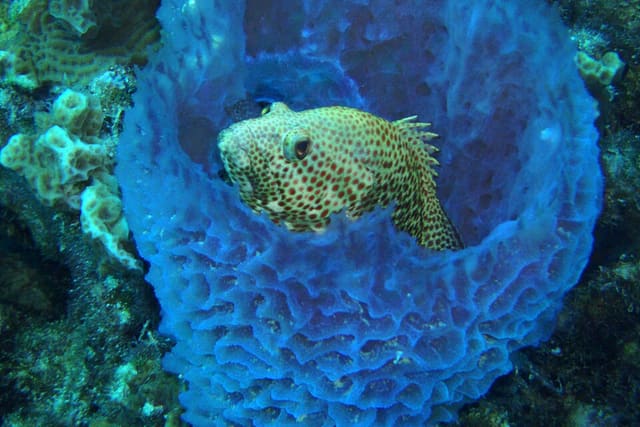
Photo: Chris Coccaro, NOAA, Public domain, via Wikimedia Commons. Cropped.
A rock hind (a fish) resting in a sponge on a reef in Bonaire. The sponge has no backbone, eyes or legs, but it is still an animal.
How often it shows up in past papers
Paper 1 counts come from our past-paper bank of CSEC Biology Paper 1s. Paper 2 is not included yet.
Groups make a million kinds of living thing manageable
Scientists have named well over a million kinds of organism. Putting them into groups by the features they share helps people in real ways. Tap each card.
Every living thing fits one of five kingdoms
A kingdom is the largest group. Three questions sort them: does each cell have a nucleus, can it make its own food, and does it have a cell wall?
Which kingdom?
Tap a kingdom on the list to see what puts an organism in it.
Viruses are left out: they are not made of cells. Scientists now also compare DNA to check which groups are related.
From the biggest group to one species
Here is where humans sit. Drag or tap each group into its slot, biggest first.
Which group is the biggest?
Six terms to know cold
Say what each term means before you flip the card. If you were close, flip it anyway and check the wording.
Six quick questions, then a real one
Pick an answer to see why it’s right or wrong.
Which feature tells you that an animal is an insect and not a spider?
A student is classifying an animal she has never seen before. Which feature is LEAST useful?
A leaf has veins that run side by side from base to tip. Which plant is it most likely from?
Why is a mushroom placed in the kingdom Fungi and not Plantae?
Which organism belongs to the kingdom Protoctista?
An animal has dry, scaly skin and lays eggs with leathery shells on land. Which class is it in?
exam style · 2 marks
A student finds a small animal with eight legs and a body in two parts on a hibiscus bush. Explain why it is NOT an insect.
Sign in to have your answer marked, or check it against the mark scheme. Sign in
Practice questions are written by My V.I.P. Academy. They are not official CXC papers.