Specialised cells
Your body has around 200 kinds of cell, and each is shaped for its job. These specialised cells group into tissues, tissues into organs, and organs into systems.
By the end of this page you can
- Explain why multicellular organisms have specialised cells
- Link the structure of six specialised cells to their jobs
- Put the levels of organisation in order
- Define tissue, organ, organ system and division of labour
- Explain how two named cells are adapted to their jobs
Goals tick themselves off as you try the activities below.
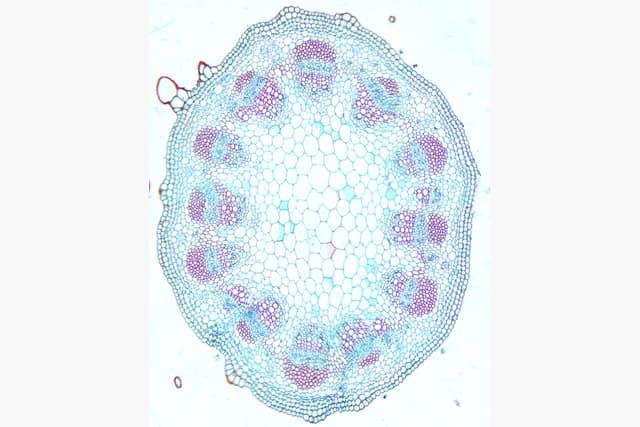
Photo: Tgru001, CC BY 4.0, via Wikimedia Commons. Resized and set on its own background colour, JPEG q72.
One stem, several tissues: epidermis on the outside, a ring of xylem and phloem bundles, and packing cells in the middle.
How often it shows up in past papers
Paper 1 counts come from our past-paper bank of CSEC Biology Paper 1s. Paper 2 is not included yet.
Shape fits the job
Tap each card.
Six cells, six jobs
Tap a cell to see how its structure fits its job.
What is it built for?
Pick a cell on the list.
This is division of labour: each cell does one job very well but depends on the others. A single-celled Amoeba must do every job itself.
From one cell to you
Drag or tap each card into its slot, smallest first.
What is the smallest unit?
Seven terms to know cold
Say what each term means before you flip the card. Always link a structure to its job.
Six quick questions, then a real one
Pick an answer to see why it’s right or wrong.
A group of similar cells carrying out the same function is
A root hair cell is adapted to absorb water by having
A red blood cell has no nucleus so that it
A leaf is an example of
Which is the correct order?
Why do large organisms have specialised cells?
exam style · 4 marks
Explain how TWO named specialised cells are adapted to their functions.
Sign in to have your answer marked, or check it against the mark scheme. Sign in
Practice questions are written by My V.I.P. Academy. They are not official CXC papers.