Blood, defence and immunisation
Seconds after you cut yourself, threads of fibrin start to form a net that traps red blood cells, like the tangle here. Blood carries oxygen and food, but it is also an army: it seals wounds, swallows germs and remembers them, which is how vaccines work.
By the end of this page you can
- Describe how white cells, clotting and vaccines defend the body
- Relate each part of the blood to its job
- Put the stages of blood clotting in order
- Define antibody, antigen, phagocytosis and immunity
- Explain how vaccines control communicable diseases
Goals tick themselves off as you try the activities below.
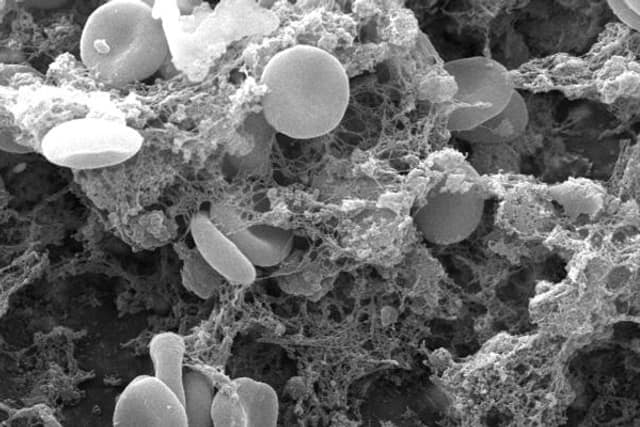
Photo: Janice Carr (US CDC), Public domain, via Wikimedia Commons. Cropped (scale-bar text removed), resized, JPEG q72.
Red blood cells trapped in a fibrin net: the start of a clot, seen with a scanning electron microscope.
How often it shows up in past papers
Paper 1 counts come from our past-paper bank of CSEC Biology Paper 1s. Paper 2 is not included yet.
Three lines of defence
White cells destroy pathogens; antibodies label them; vaccines train the body before it meets them. Tap each card.
Structure fits the job
Each part of the blood is built for its job.
What does it do?
Tap a part on the list to see its structure and job.
Immunity can be natural (after an infection, or a mother’s antibodies via placenta and milk) or artificial (a vaccine, or injected antibodies).
How a cut seals
You cut your finger. Put the stages of clotting in order. Drag or tap each card into its slot.
What happens first?
Seven terms to know cold
Say what each term means before you flip the card. Antibody and antigen are the pair most often mixed up.
Six quick questions, then a real one
Pick an answer to see why it’s right or wrong.
Why does a red blood cell have no nucleus?
Phagocytes defend the body by
During clotting, which change takes place?
A vaccine protects a person because it
A baby receives antibodies in its mother’s breast milk. This is
Which part of the blood carries urea and carbon dioxide?
exam style · 3 marks
Explain how a vaccine protects a child from measles.
Sign in to have your answer marked, or check it against the mark scheme. Sign in
Practice questions are written by My V.I.P. Academy. They are not official CXC papers.